Case Study
Case Study
Scientific Data Platform
The Platform for Discoverability, Governance & AI-Driven Research.
Year:
2025
Industry:
Healthcare & Life Sciences
Team:
28 people

Approach
The engagement began with a focused audit and discovery phase to assess architecture, user experience, and operational maturity. In parallel, we analyzed data catalogs, APIs, governance layers, compute environments, and data lineage to identify integration gaps, decision fragmentation, and scalability constraints. Through qualitative research—including interviews, contextual inquiry, and journey mapping—we refined personas, identified pain points, and exposed process inefficiencies. These insights revealed friction across discovery, validation, and data utilization stages, guiding the prioritization of AI use cases such as intelligent recommendations, metadata enrichment, contextual exploration, and automated governance enforcement. This combined analysis balanced user value, technical feasibility, and strategic alignment—forming the foundation for the transition toward a Controlled Autonomy Architecture.
The engagement began with a focused audit and discovery phase to assess architecture, user experience, and operational maturity. In parallel, we analyzed data catalogs, APIs, governance layers, compute environments, and data lineage to identify integration gaps, decision fragmentation, and scalability constraints. Through qualitative research—including interviews, contextual inquiry, and journey mapping—we refined personas, identified pain points, and exposed process inefficiencies. These insights revealed friction across discovery, validation, and data utilization stages, guiding the prioritization of AI use cases such as intelligent recommendations, metadata enrichment, contextual exploration, and automated governance enforcement. This combined analysis balanced user value, technical feasibility, and strategic alignment—forming the foundation for the transition toward a Controlled Autonomy Architecture.
The engagement began with a focused audit and discovery phase to assess architecture, user experience, and operational maturity. In parallel, we analyzed data catalogs, APIs, governance layers, compute environments, and data lineage to identify integration gaps, decision fragmentation, and scalability constraints. Through qualitative research—including interviews, contextual inquiry, and journey mapping—we refined personas, identified pain points, and exposed process inefficiencies. These insights revealed friction across discovery, validation, and data utilization stages, guiding the prioritization of AI use cases such as intelligent recommendations, metadata enrichment, contextual exploration, and automated governance enforcement. This combined analysis balanced user value, technical feasibility, and strategic alignment—forming the foundation for the transition toward a Controlled Autonomy Architecture.
Architecture
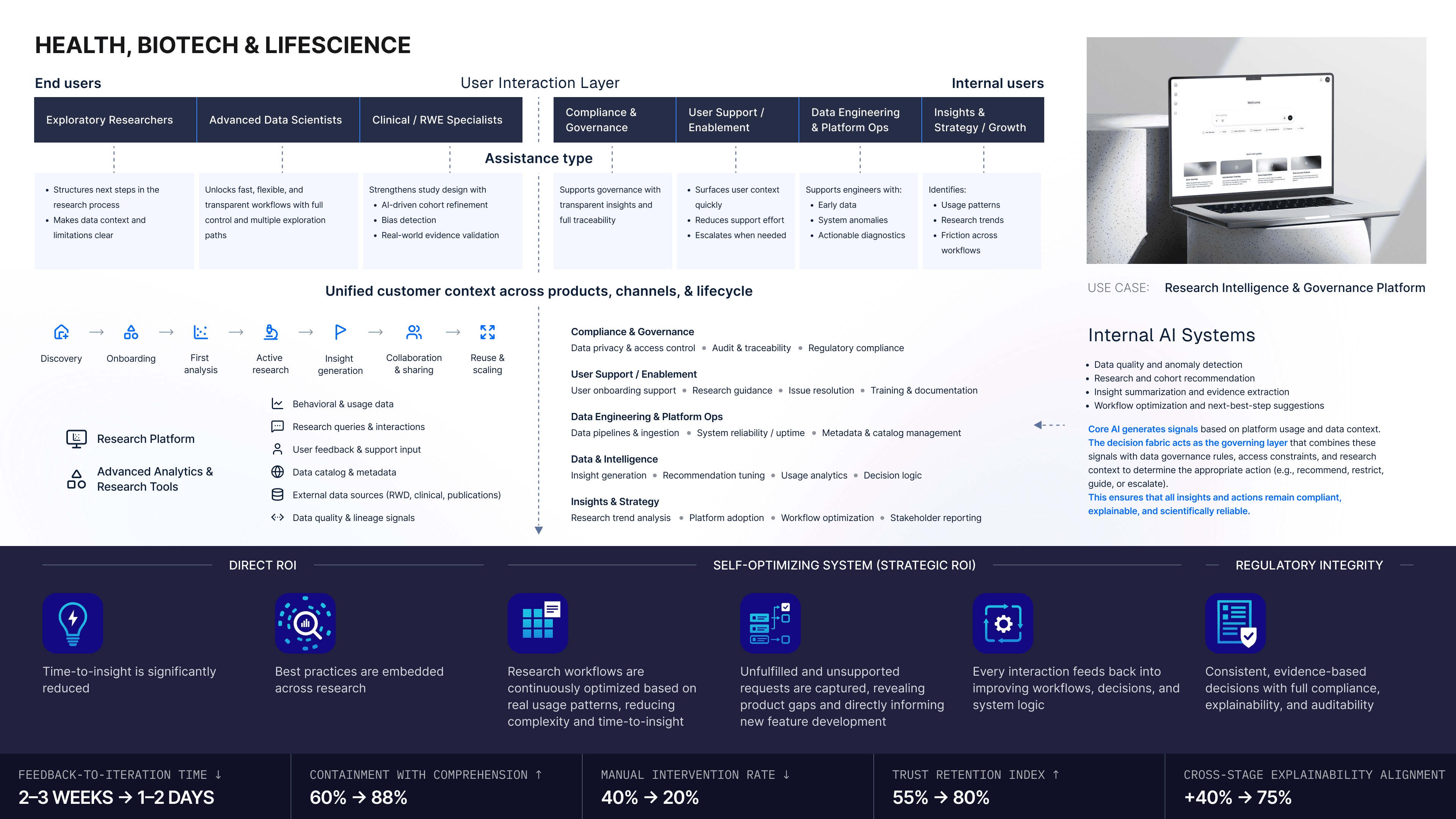
Building on these insights, we defined a Controlled Autonomy Architecture for the Data Platform—structuring the system into coordinated layers of signal generation, decision governance, and execution. Core AI continuously generates signals from user behavior, data context, and system activity. A centralized Decision Fabric acts as the governing layer, applying policies, access rules, and strategic constraints to ensure consistent and compliant decision-making. Execution is handled by modular agents that dynamically orchestrate user interactions, data workflows, and system responses. This architecture embeds governance directly into the decision-making process, enabling adaptive behavior while maintaining full control, traceability, and alignment across all operations.
Building on these insights, we defined a Controlled Autonomy Architecture for the Data Platform—structuring the system into coordinated layers of signal generation, decision governance, and execution. Core AI continuously generates signals from user behavior, data context, and system activity. A centralized Decision Fabric acts as the governing layer, applying policies, access rules, and strategic constraints to ensure consistent and compliant decision-making. Execution is handled by modular agents that dynamically orchestrate user interactions, data workflows, and system responses. This architecture embeds governance directly into the decision-making process, enabling adaptive behavior while maintaining full control, traceability, and alignment across all operations.
Building on these insights, we defined a Controlled Autonomy Architecture for the Data Platform—structuring the system into coordinated layers of signal generation, decision governance, and execution. Core AI continuously generates signals from user behavior, data context, and system activity. A centralized Decision Fabric acts as the governing layer, applying policies, access rules, and strategic constraints to ensure consistent and compliant decision-making. Execution is handled by modular agents that dynamically orchestrate user interactions, data workflows, and system responses. This architecture embeds governance directly into the decision-making process, enabling adaptive behavior while maintaining full control, traceability, and alignment across all operations.
Outcome
The collaboration established a scalable foundation for governed, AI-driven data platforms—enhancing discoverability, usability, and operational efficiency. The system evolved into a continuously learning environment capable of delivering context-aware experiences, explainable automation, and optimized data workflows. At the same time, it ensures that all decisions remain transparent, auditable, and aligned with organizational policies. This transformation positions the platform as a reference model for data-intensive organizations—demonstrating how Controlled Autonomy Architectures unify intelligence, governance, and execution into a single adaptive system that continuously improves.
The collaboration established a scalable foundation for governed, AI-driven data platforms—enhancing discoverability, usability, and operational efficiency. The system evolved into a continuously learning environment capable of delivering context-aware experiences, explainable automation, and optimized data workflows. At the same time, it ensures that all decisions remain transparent, auditable, and aligned with organizational policies. This transformation positions the platform as a reference model for data-intensive organizations—demonstrating how Controlled Autonomy Architectures unify intelligence, governance, and execution into a single adaptive system that continuously improves.
The collaboration established a scalable foundation for governed, AI-driven data platforms—enhancing discoverability, usability, and operational efficiency. The system evolved into a continuously learning environment capable of delivering context-aware experiences, explainable automation, and optimized data workflows. At the same time, it ensures that all decisions remain transparent, auditable, and aligned with organizational policies. This transformation positions the platform as a reference model for data-intensive organizations—demonstrating how Controlled Autonomy Architectures unify intelligence, governance, and execution into a single adaptive system that continuously improves.
FEEDBACK-TO-ITERATION TIME ↓
2–3W → 1–2D
CONTAINMENT WITH COMPREHENSION ↑
60% → 88%
MANUAL INTERVENTION RATE ↓
40% → 20%
TRUST RETENTION INDEX ↑
55% → 80%
Cross-Stage Explainability Alignment
+40% → 75%
hours/month saved
+15%
More projects





Ready to start?
Get in touch
Whether you have questions or just want to explore options, I'm here.

Ready to start?
Get in touch
Whether you have questions or just want to explore options, I'm here.
Ready to start?
Get in touch
Whether you have questions or just want to explore options, I'm here.