Case Study
Case Study
Travel Intelligence System
Travel intelligence platform governing real-time pricing, inventory, and booking decisions
Year:
2026
Industry:
TRAVELTECH
Team:
40 people

Approach
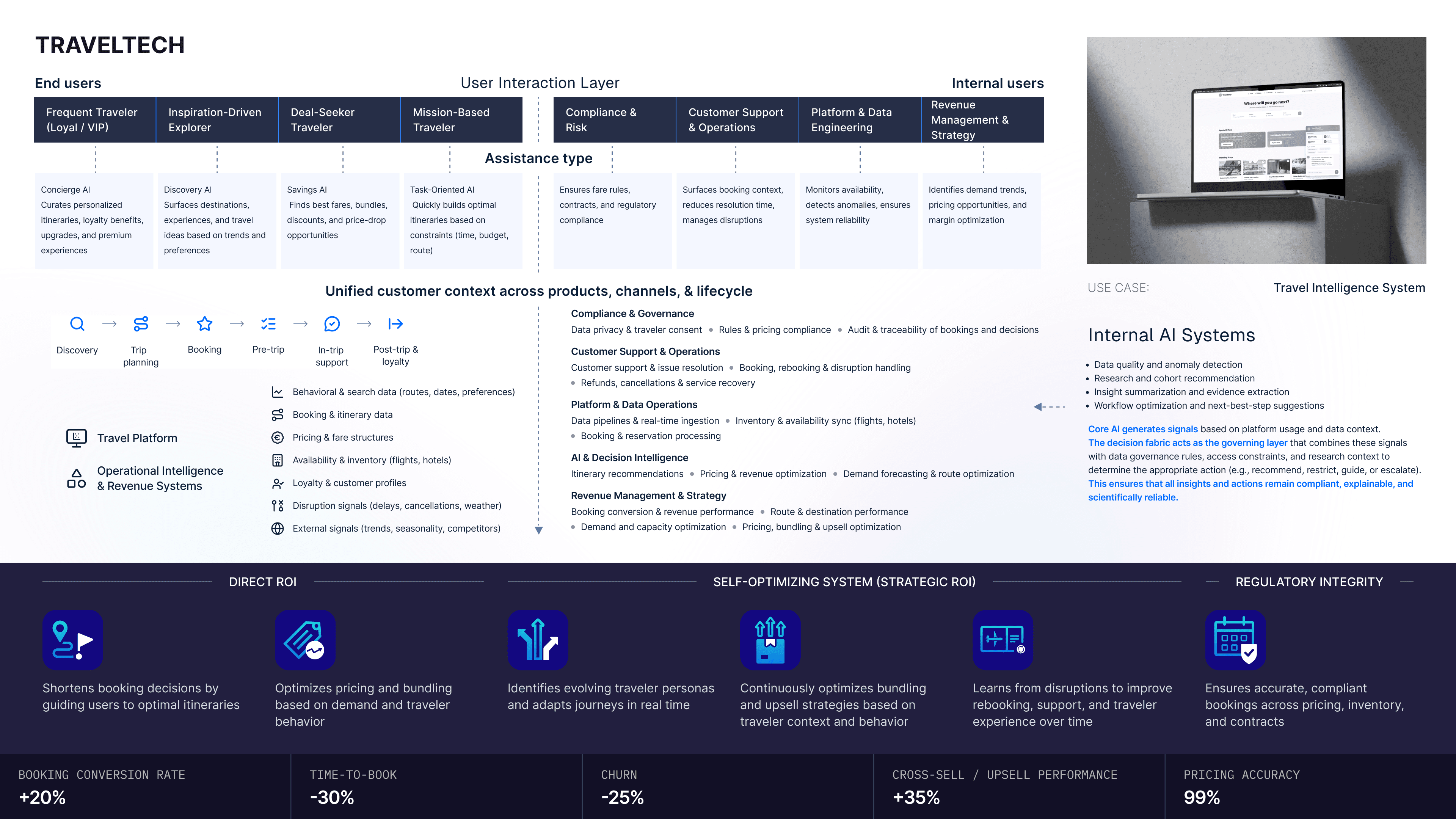
We assessed how traveler signals, inventory data, and pricing logic drive booking and operational decisions. This exposed gaps between intent detection, availability, and execution—impacting conversion, pricing precision, and disruption handling. Journey analysis across traveler types revealed inconsistencies in planning, booking, and post-booking stages. These insights led to a Controlled Autonomy Architecture, aligning real-time signals, governed decisions, and adaptive execution.
We assessed how traveler signals, inventory data, and pricing logic drive booking and operational decisions. This exposed gaps between intent detection, availability, and execution—impacting conversion, pricing precision, and disruption handling. Journey analysis across traveler types revealed inconsistencies in planning, booking, and post-booking stages. These insights led to a Controlled Autonomy Architecture, aligning real-time signals, governed decisions, and adaptive execution.
We assessed how traveler signals, inventory data, and pricing logic drive booking and operational decisions. This exposed gaps between intent detection, availability, and execution—impacting conversion, pricing precision, and disruption handling. Journey analysis across traveler types revealed inconsistencies in planning, booking, and post-booking stages. These insights led to a Controlled Autonomy Architecture, aligning real-time signals, governed decisions, and adaptive execution.
Architecture
The system is structured as a layered model integrating signal intelligence, decision governance, and execution orchestration. A unified context layer aggregates search, booking, pricing, and disruption signals. Core AI generates insights on demand, routes, and traveler behavior, while the decision layer applies constraints across pricing, inventory, and compliance. Execution agents dynamically manage recommendations, booking flows, and rebooking scenarios.
The system is structured as a layered model integrating signal intelligence, decision governance, and execution orchestration. A unified context layer aggregates search, booking, pricing, and disruption signals. Core AI generates insights on demand, routes, and traveler behavior, while the decision layer applies constraints across pricing, inventory, and compliance. Execution agents dynamically manage recommendations, booking flows, and rebooking scenarios.
The system is structured as a layered model integrating signal intelligence, decision governance, and execution orchestration. A unified context layer aggregates search, booking, pricing, and disruption signals. Core AI generates insights on demand, routes, and traveler behavior, while the decision layer applies constraints across pricing, inventory, and compliance. Execution agents dynamically manage recommendations, booking flows, and rebooking scenarios.
Outcome
We assessed how traveler signals, inventory data, and pricing logic drive booking and operational decisions. This exposed gaps between intent detection, availability, and execution—impacting conversion, pricing precision, and disruption handling. Journey analysis across traveler types revealed inconsistencies in planning, booking, and post-booking stages. These insights led to a Controlled Autonomy Architecture, aligning real-time signals, governed decisions, and adaptive execution.
We assessed how traveler signals, inventory data, and pricing logic drive booking and operational decisions. This exposed gaps between intent detection, availability, and execution—impacting conversion, pricing precision, and disruption handling. Journey analysis across traveler types revealed inconsistencies in planning, booking, and post-booking stages. These insights led to a Controlled Autonomy Architecture, aligning real-time signals, governed decisions, and adaptive execution.
We assessed how traveler signals, inventory data, and pricing logic drive booking and operational decisions. This exposed gaps between intent detection, availability, and execution—impacting conversion, pricing precision, and disruption handling. Journey analysis across traveler types revealed inconsistencies in planning, booking, and post-booking stages. These insights led to a Controlled Autonomy Architecture, aligning real-time signals, governed decisions, and adaptive execution.
Booking Conversion Rate
+20%
Time-to-Book
-30%
Churn
-25%
Cross-sell / Upsell performance
+35%
Increase in CLV
99%
REBOOKING SUCCESS RATE
+40%
More projects




Ready to start?
Get in touch
Whether you have questions or just want to explore options, I'm here.

Ready to start?
Get in touch
Whether you have questions or just want to explore options, I'm here.
Ready to start?
Get in touch
Whether you have questions or just want to explore options, I'm here.