A Framework for Interoperable and Self-Optimizing Agentic Systems
The Hidden Power Behind Scalable AI: Agentic Experience Architectures


1. Deterministic Routing Rules
Goal: Reduce ambiguity and waste.
The orchestrator routes via capability maps, intent extraction, and rule-based logic, using LLMs only when uncertainty is high.
Agents are selected deterministically, not through trial-and-error — eliminating redundant calls and routing chaos.
2. State-Aware Planning
Goal: Force linear, controlled progress.
Workflows use explicit state models and allowed transitions.
The planner reads the current state, completed steps, and permitted next actions before planning.
Termination rules prevent infinite refinement, looping, or uncontrolled expansion.
3. Memory-Guided Behaviors
Goal: Reuse, not recompute.
Agents rely on shared state, semantic memory, and cached tool outputs rather than regenerating context every turn.
Memory is updated centrally, ensuring continuity and preventing drift or repetitive work.
Result: Predictable Cost & Behavior
Combining deterministic routing, state-driven planning, and memory governance yields:
Single, intentional agent calls
No loops or redundant computation
Smaller, cheaper reasoning steps
Fully predictable execution budgets
Loop Avoidance Through Structured Orchestration
1. Explicit Stop Conditions
Define hard limits on steps, task depth, retries, and “no-progress” iterations.
The orchestrator checks these before every step and forces termination or escalation when limits are hit.
2. Stage-Level Routing
Use a state machine with fixed stages and allowed transitions.
Each stage has specific agents/tools, and the orchestrator—not the agents—controls movement between stages.
3. Role-Bound Agents
Agents have strict roles, domains, and allowed tools.
Planners cannot execute tools, executors cannot spawn new tasks, and no agent directly calls another.
All actions go through the orchestrator.
4. Telemetry-Driven Guardrails
Log every step (agent, stage, tool, tokens, state changes).
Detect patterns like ping-pong loops, retry storms, or no-progress iterations.
When detected, block further repetition and force summarization or escalation.
5. Orchestration Loop
Per step:
load state,
check stop conditions,
select agent via stage rules,
execute once,
update memory/state,
log telemetry.
Agents never negotiate directly—structure prevents loops by design.
Efficient Use of Shared Memory & Semantic Memory

1. Two-Layer Memory Model
Shared Memory = canonical, structured state (stage, slots, constraints, facts).
Semantic Memory = embeddings of conversations, docs, logs, and domain knowledge.
2. Shared Memory as Ground Truth
Define a fixed schema and store it centrally (Redis/Postgres).
Orchestrator loads it before every agent call and updates it after every step.
Agents must read from Shared Memory first and update it through structured outputs.
3. Centralized Semantic Retrieval
Store all long-form text as vectors in a vector DB.
Orchestrator retrieves top-k relevant chunks per step (not the agents).
Fuse them into the prompt after Shared Memory.
4. “Refer, Don’t Guess” Enforcement
Agents cannot invent missing facts or create their own memory.
If information is missing, they must ask or call tools—never hallucinate.
Semantic Memory supports context; Shared Memory decides truth.
5. Result: No Drift, No Redundancy
No repeated API calls, no re-retrieval by each agent.
No conflicting states across agents.
Prompts stay small, consistent, and cheaper.
Accurate, aligned decisions across the entire agent ecosystem.
Security Elevated by Design, Not Added Later
1. Every agent is permissioned.
Each agent has a defined identity, role, and allowed capabilities.
It cannot access tools, data, or actions outside its scope.
2. Every message is validated.
The orchestrator checks structure, permissions, safety, and policy compliance
before any agent output is accepted or executed.
3. Every action is logged with traceability.
All tool calls, memory changes, stage transitions, and decisions are recorded
for auditing, debugging, and compliance.
Security becomes part of the interaction model itself—not something added afterward.
Intent-Centricity as the Core Driver
1. One structured intent model
User requests are converted into a consistent intent graph and decomposed into clear sub-intents.
2. Intents map to capabilities, not agent guesses
The orchestrator uses the intent graph to choose the correct capability every time—even for ambiguous or complex tasks.
3. Execution happens with constraints
Agents operate within strict role, policy, memory, and state boundaries to ensure reliable, aligned behavior.
Result:
Fewer errors, higher relevance, and fully explainable, compliant decisions across all workflows.
Higher Orchestration Quality
1. Planner–router separation creates disciplined orchestration.
The planner analyzes intent and breaks tasks into structured steps, while the router enforces stage rules and assigns the correct capability-bound agent.
This prevents agents from improvising workflows and guarantees consistent, deterministic execution paths.
2. Workflows become predictable, explainable, and testable.
By grounding actions in predefined task structures, allowed transitions, and capability maps, AEA ensures that every request follows the same governed lifecycle.
Stages hand off cleanly, transitions cannot be skipped or reversed, and the system behaves the same way every time.
3. Execution is multimodal, policy-bound, and fully observable.
The router selects modality-appropriate agents, enforces compliance and role limits, and produces complete audit trails of all decisions.
This yields global visibility of agent behaviors, better quality control, and orchestration that scales safely across domains.
Result:
Orchestration shifts from an emergent, agent-driven process into a controlled, governed system with higher reliability, clarity, and operational quality.
Natural Adoption Across Teams
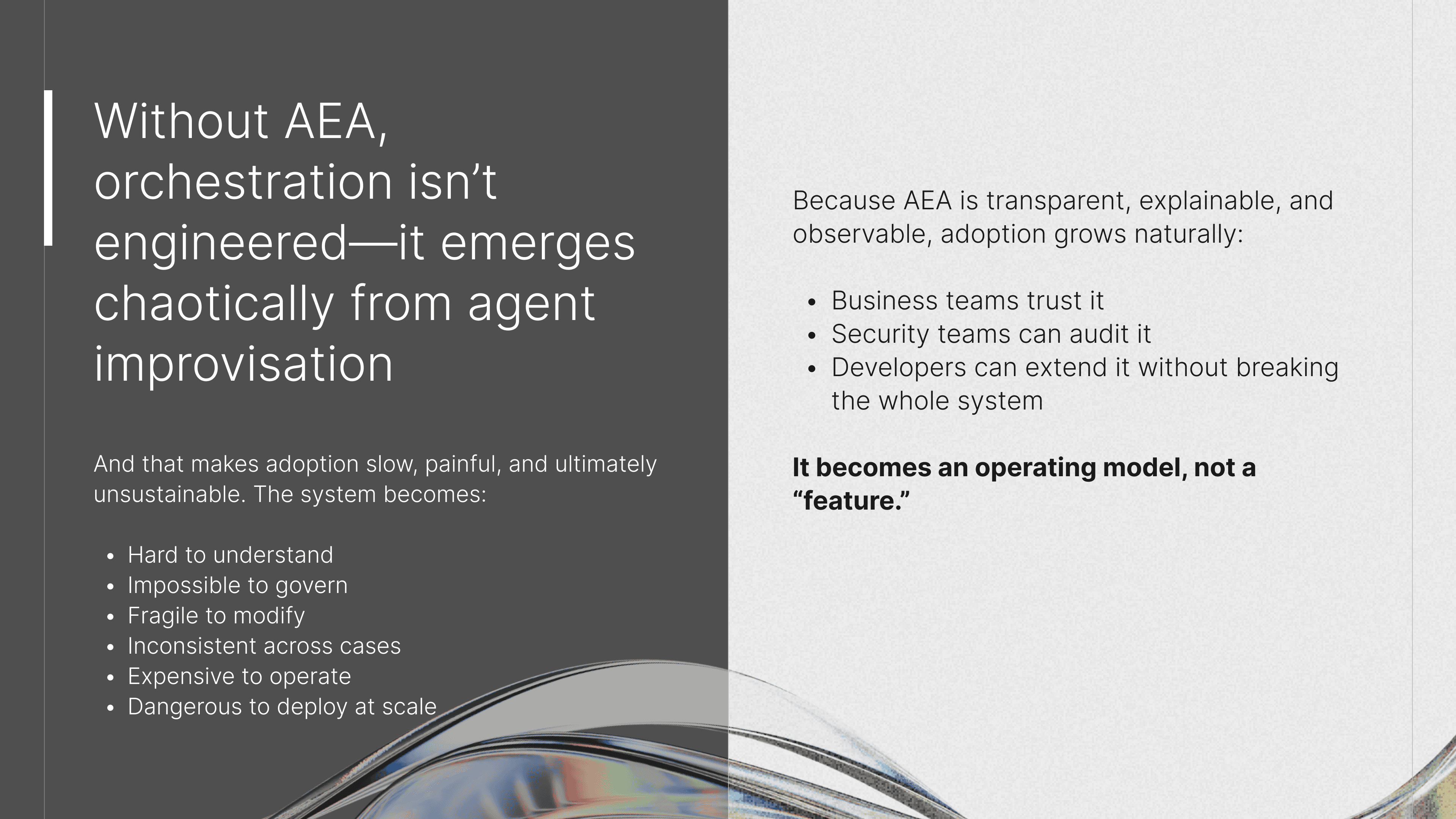
AEA prevents chaos by transforming agent systems from improvisational swarms into a governed, deterministic operating model.
Instead of allowing agents to interpret tasks independently, AEA structures intent, constrains behavior, and enforces predictable workflows.
It does this by grounding every request in a shared intent model, ensuring that all agents understand the task the same way.
Planner–router separation guarantees that reasoning and execution remain distinct, eliminating the messy negotiations and misrouted chains of actions that cause loops and drift.
A formal state machine governs progression, preventing jumps, regressions, or forgotten steps, and ensuring that every workflow follows a stable, testable path from beginning to end.
Agents themselves become role-bound components with strict permissions, limited tools, and clear responsibilities—unable to modify state outside their domain or trigger uncontrolled cascades.
Shared Memory gives the entire ecosystem one canonical reality, removing contradictory interpretations and duplicated work, while Semantic Memory ensures retrieval is efficient and consistent.
Loop controls, retry limits, and termination rules stop runaway computation and unpredictable cost spikes.
Every action is validated, logged, and auditable, enabling security and compliance teams to fully trust the system’s behavior.
And with centralized observability, the entire orchestration becomes visible, measurable, and continuously improvable.
By hardwiring structure, constraints, governance, and transparency into the interaction model, AEA creates a system that scales naturally across teams because it is predictable, explainable, and safe—an operational backbone, not an experimental feature.
Predictability & Stability of System Behavior
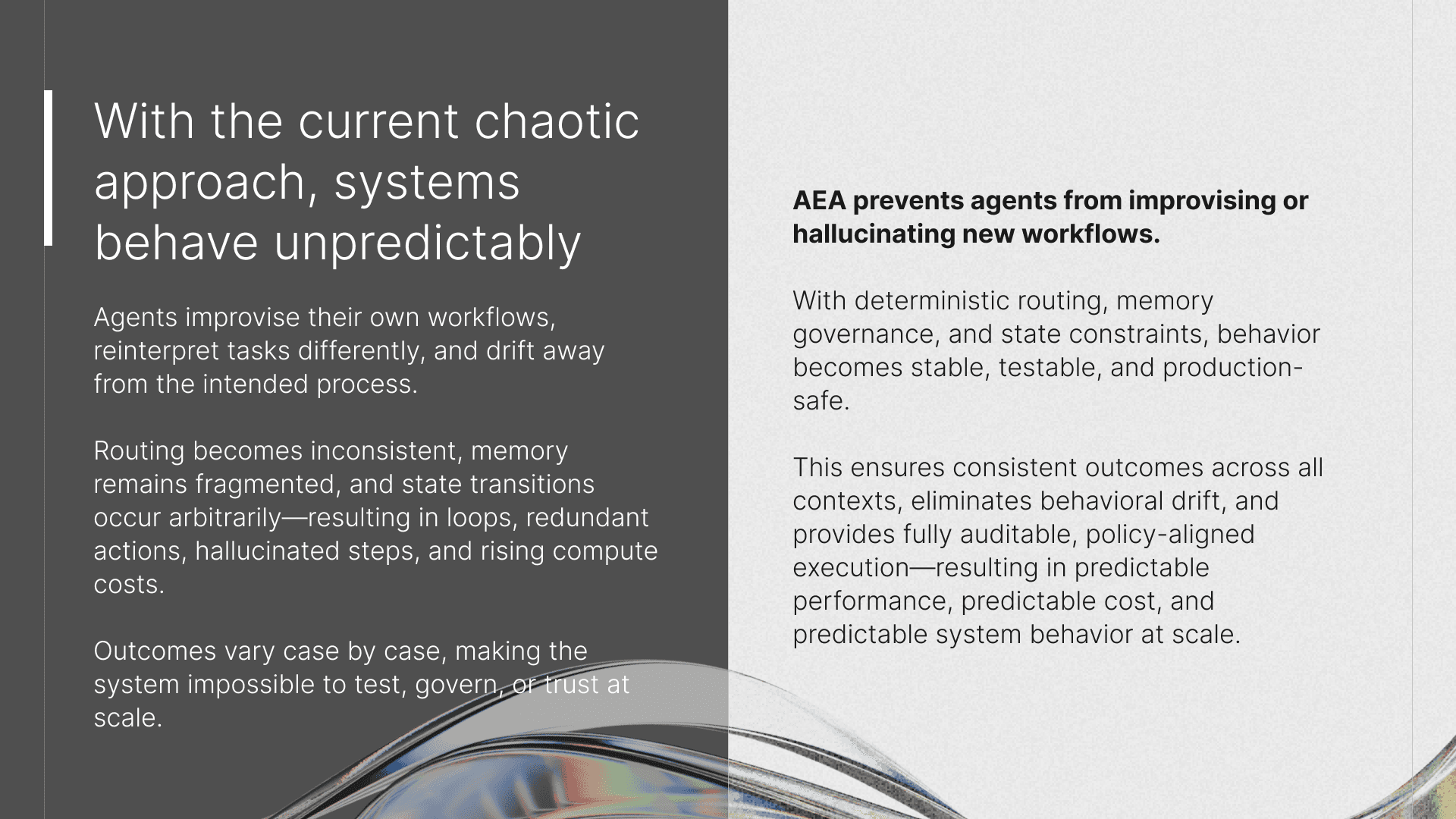
AEA delivers predictable and stable system behavior by replacing improvisation with a governed, constraint-driven execution model. Instead of allowing agents to invent their own workflows, reinterpret tasks, or rely on fragmentary context, AEA introduces strict orchestration rules that standardize how decisions are made, how information is retrieved, and how workflows progress. This ensures every request follows the same controlled pathway, regardless of agent, modality, or complexity.
With deterministic routing, the orchestrator—not the agents—decides who acts next, eliminating accidental or inconsistent handoffs. Shared Memory provides one canonical operational truth, preventing drift, duplication, and contradicting interpretations of state. Semantic Memory retrieval is centralized, meaning agents always rely on validated, relevant context rather than improvising their own. Explicit state machines govern how tasks evolve across stages, blocking illegal transitions and enforcing forward progress.
Role-bound permissions prevent agents from acting outside their intended functions, reducing behavioral anomalies and accidental tool usage. Loop-guards and termination rules halt runaway chains of thought, circular reasoning, and over-planning. Every action, decision, and state change is logged, providing transparency and auditability that allow teams to analyze, debug, and trust the system’s behavior.
This collective structure transforms an agent ecosystem from unpredictable emergent behavior into a disciplined, testable, and stable operational model. AEA ensures consistent outputs, stable costs, policy-aligned actions, and production-safe performance—even at enterprise scale and under complex workloads. It makes the system not only more reliable, but fundamentally governable.
Full Observability & Explainability
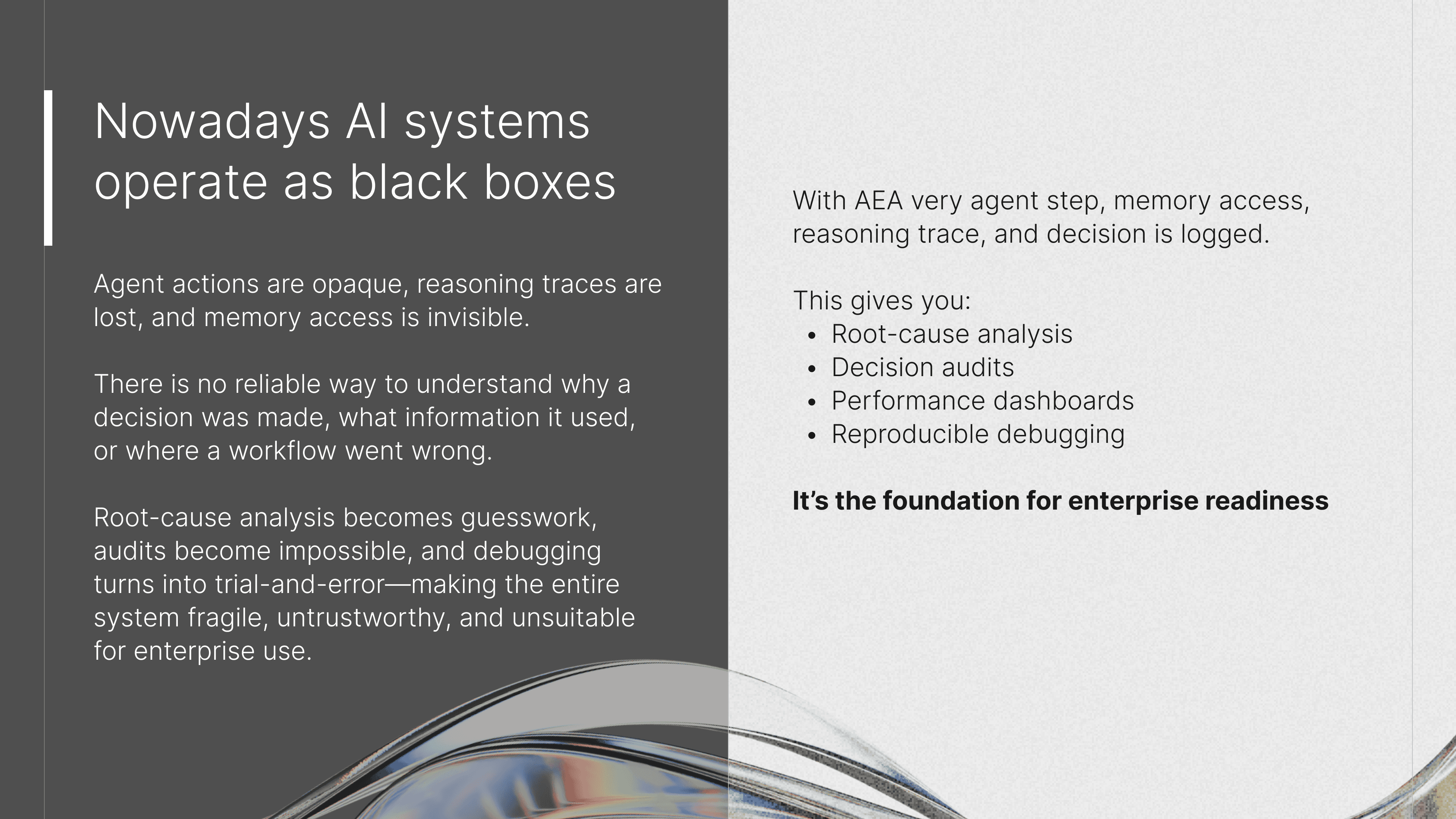
AEA replaces black-box behavior with complete, structured visibility across the entire agent ecosystem.
With AEA:
Every agent action is traceable
Inputs, outputs, and intermediate reasoning are captured as structured events.
No step happens silently or implicitly.
Execution becomes debuggable, auditable, and reproducible.
Memory usage becomes transparent and governed
Shared Memory reads/writes are logged with exact fields and diffs.
Semantic Memory retrievals capture queries, matches, and similarity scores.
No hidden, silent, or untracked context use.
Reasoning becomes inspectable
Full reasoning traces are captured privately for audit.
Redacted summaries support compliance and debugging.
Teams can understand why the system reached a decision, not just what it returned.
Retrieval becomes deterministic
Agents no longer perform ad-hoc searches.
All retrieval is orchestrated, logged, and validated.
Guarantees consistent context and prevents drift or contradiction.
State transitions become explicit
Every change of workflow stage is recorded with cause, agent, and validation.
Illegal or accidental transitions are blocked.
System behavior becomes predictable and governed.
The full execution path becomes replayable
Any workflow can be reconstructed step-by-step.
Failures become analyzable instead of mysterious.
Root-cause analysis stops being guesswork.
End-to-end dashboards emerge naturally
Performance, cost, agent accuracy, memory quality, and routing behavior become visible.
Teams gain real-time insight into how AI operates at scale.
Drift, anomalies, bottlenecks, and loops are detectable instantly.
Audits and safety reviews become trivial
You can show regulators or internal security exactly:
what data was used
what reasoning occurred
what tools were invoked
why a decision was made
No untraceable “ghost logic.”
The system becomes enterprise-safe
No black-box behavior.
No unobservable mistakes.
No ungovernable workflows.
Modular Expansion Without Breaking the System
AEA turns agents into plug-compatible components, not fragile interdependent units.
With AEA:
Interfaces are standardized
Every agent consumes and produces the same structured formats.
No custom protocols or ad-hoc formats that break compatibility.
Capabilities are formalized
Orchestrator routes by capability, not agent name or LLM guesses.
New capabilities can be added without touching existing logic.
Contracts enforce behavior
Schema validation, permission checks, and tool restrictions prevent breakage.
Agents cannot drift from expected behavior or write malformed data.
Memory schemas unify the system
Shared Memory follows strict, versioned schemas.
Agents never invent their own data formats, preventing incompatibility.
Clear boundaries prevent entanglement
Planning, routing, execution, and tools are decoupled.
Adding a new agent never creates new hidden dependencies.
Versioning protects existing workflows
New agents, capabilities, and schemas can evolve without breaking old flows.
Workflows bind to exact versions, guaranteeing stability.
Tool access is abstracted
Agents call standardized tool interfaces, not raw APIs.
Tools evolve behind the contract without affecting agents.
The whole system becomes modular
New agents snap in like LEGO pieces.
Teams can innovate without destabilizing the platform.
No more “spaghetti of agents” or hidden coupling.