A Framework for Interoperable and Self-Optimizing Agentic Systems
The Role of Vendor-Neutral Agents in Agentic Experience Architectures

Overview
Overview
In an Agentic Experience Architecture, where autonomous agents collaborate, reason, and adapt across multiple layers of cognition and service orchestration, vendor-neutral agents serve as the foundation of flexibility, trust, and longevity.
They are not tied to a specific AI provider or proprietary SDK — instead, they interact through standardized schemas, abstracted capabilities, and policy-driven routing. This abstraction ensures that the agent’s purpose, reasoning logic, and experience design remain independent of any single vendor’s infrastructure or API.
Vendor-neutral agents enable organizations to build systems that adapt to shifting technologies, regulatory requirements, and user contexts without rewriting the core architecture. They allow orchestrators and routers to dynamically select the most appropriate model or provider — whether for cost efficiency, data residency, latency, or capability specialization — all while maintaining consistent user experience and behavioral integrity.
In essence, vendor-neutral agents are the enablers of sustainable agentic ecosystems: they transform what could be a fragile network of vendor-bound components into an interoperable, composable intelligence layer capable of continuous evolution.
In an Agentic Experience Architecture, where autonomous agents collaborate, reason, and adapt across multiple layers of cognition and service orchestration, vendor-neutral agents serve as the foundation of flexibility, trust, and longevity.
They are not tied to a specific AI provider or proprietary SDK — instead, they interact through standardized schemas, abstracted capabilities, and policy-driven routing. This abstraction ensures that the agent’s purpose, reasoning logic, and experience design remain independent of any single vendor’s infrastructure or API.
Vendor-neutral agents enable organizations to build systems that adapt to shifting technologies, regulatory requirements, and user contexts without rewriting the core architecture. They allow orchestrators and routers to dynamically select the most appropriate model or provider — whether for cost efficiency, data residency, latency, or capability specialization — all while maintaining consistent user experience and behavioral integrity.
In essence, vendor-neutral agents are the enablers of sustainable agentic ecosystems: they transform what could be a fragile network of vendor-bound components into an interoperable, composable intelligence layer capable of continuous evolution.
In an Agentic Experience Architecture, where autonomous agents collaborate, reason, and adapt across multiple layers of cognition and service orchestration, vendor-neutral agents serve as the foundation of flexibility, trust, and longevity.
They are not tied to a specific AI provider or proprietary SDK — instead, they interact through standardized schemas, abstracted capabilities, and policy-driven routing. This abstraction ensures that the agent’s purpose, reasoning logic, and experience design remain independent of any single vendor’s infrastructure or API.
Vendor-neutral agents enable organizations to build systems that adapt to shifting technologies, regulatory requirements, and user contexts without rewriting the core architecture. They allow orchestrators and routers to dynamically select the most appropriate model or provider — whether for cost efficiency, data residency, latency, or capability specialization — all while maintaining consistent user experience and behavioral integrity.
In essence, vendor-neutral agents are the enablers of sustainable agentic ecosystems: they transform what could be a fragile network of vendor-bound components into an interoperable, composable intelligence layer capable of continuous evolution.
Benefits of Vendor-Neutral Agents in Agentic Experience Architectures
Benefits of Vendor-Neutral Agents in Agentic Experience Architectures
Benefits of Vendor-Neutral Agents in Agentic Experience Architectures
1. Sustainability and Future-Proofing
Vendor-neutral agents decouple experience logic from provider dependencies.
This ensures that architectural investments remain durable even as APIs, pricing models, or providers evolve — preserving the continuity of user experiences and system integrity.
2. Resilience and Redundancy
By abstracting model dependencies, orchestration layers can route tasks to alternative vendors or self-hosted models during outages, quota limits, or latency spikes — maintaining operational uptime and user trust.
3. Regulatory and Policy Flexibility
Different journeys may require different compliance boundaries (e.g., healthcare vs. marketing). Vendor-neutral agents allow policy-based routing, ensuring that sensitive data is processed only by compliant, in-region models.
4. Optimization and Cost Efficiency
Agents can dynamically select models based on context, confidence, and cost-performance trade-offs, enabling intelligent load balancing across vendors without breaking logic or user flow.
5. Consistent User Experience
Because reasoning, memory, and orchestration logic remain stable across providers, users experience predictable behavior and consistent feedback loops, even if the underlying AI vendor changes.
6. Interoperability and Composability
Vendor-neutral design enables seamless collaboration between agents powered by different providers.
This allows multi-model cooperation — e.g., one agent using a vision model, another using a domain-specific LLM — all coordinated under a unified experience layer.
7. Governance, Traceability, and Explainability
Standardized schemas, metadata logging, and model-agnostic observability provide full traceability across agent interactions.
This supports auditability, trust, and fine-grained optimization within regulated or high-stakes environments.
1. Sustainability and Future-Proofing
Vendor-neutral agents decouple experience logic from provider dependencies.
This ensures that architectural investments remain durable even as APIs, pricing models, or providers evolve — preserving the continuity of user experiences and system integrity.
2. Resilience and Redundancy
By abstracting model dependencies, orchestration layers can route tasks to alternative vendors or self-hosted models during outages, quota limits, or latency spikes — maintaining operational uptime and user trust.
3. Regulatory and Policy Flexibility
Different journeys may require different compliance boundaries (e.g., healthcare vs. marketing). Vendor-neutral agents allow policy-based routing, ensuring that sensitive data is processed only by compliant, in-region models.
4. Optimization and Cost Efficiency
Agents can dynamically select models based on context, confidence, and cost-performance trade-offs, enabling intelligent load balancing across vendors without breaking logic or user flow.
5. Consistent User Experience
Because reasoning, memory, and orchestration logic remain stable across providers, users experience predictable behavior and consistent feedback loops, even if the underlying AI vendor changes.
6. Interoperability and Composability
Vendor-neutral design enables seamless collaboration between agents powered by different providers.
This allows multi-model cooperation — e.g., one agent using a vision model, another using a domain-specific LLM — all coordinated under a unified experience layer.
7. Governance, Traceability, and Explainability
Standardized schemas, metadata logging, and model-agnostic observability provide full traceability across agent interactions.
This supports auditability, trust, and fine-grained optimization within regulated or high-stakes environments.
1. Sustainability and Future-Proofing
Vendor-neutral agents decouple experience logic from provider dependencies.
This ensures that architectural investments remain durable even as APIs, pricing models, or providers evolve — preserving the continuity of user experiences and system integrity.
2. Resilience and Redundancy
By abstracting model dependencies, orchestration layers can route tasks to alternative vendors or self-hosted models during outages, quota limits, or latency spikes — maintaining operational uptime and user trust.
3. Regulatory and Policy Flexibility
Different journeys may require different compliance boundaries (e.g., healthcare vs. marketing). Vendor-neutral agents allow policy-based routing, ensuring that sensitive data is processed only by compliant, in-region models.
4. Optimization and Cost Efficiency
Agents can dynamically select models based on context, confidence, and cost-performance trade-offs, enabling intelligent load balancing across vendors without breaking logic or user flow.
5. Consistent User Experience
Because reasoning, memory, and orchestration logic remain stable across providers, users experience predictable behavior and consistent feedback loops, even if the underlying AI vendor changes.
6. Interoperability and Composability
Vendor-neutral design enables seamless collaboration between agents powered by different providers.
This allows multi-model cooperation — e.g., one agent using a vision model, another using a domain-specific LLM — all coordinated under a unified experience layer.
7. Governance, Traceability, and Explainability
Standardized schemas, metadata logging, and model-agnostic observability provide full traceability across agent interactions.
This supports auditability, trust, and fine-grained optimization within regulated or high-stakes environments.
Best Approach for Agentic Experience Architectures
Best Approach for Agentic Experience Architectures
Best Approach for Agentic Experience Architectures
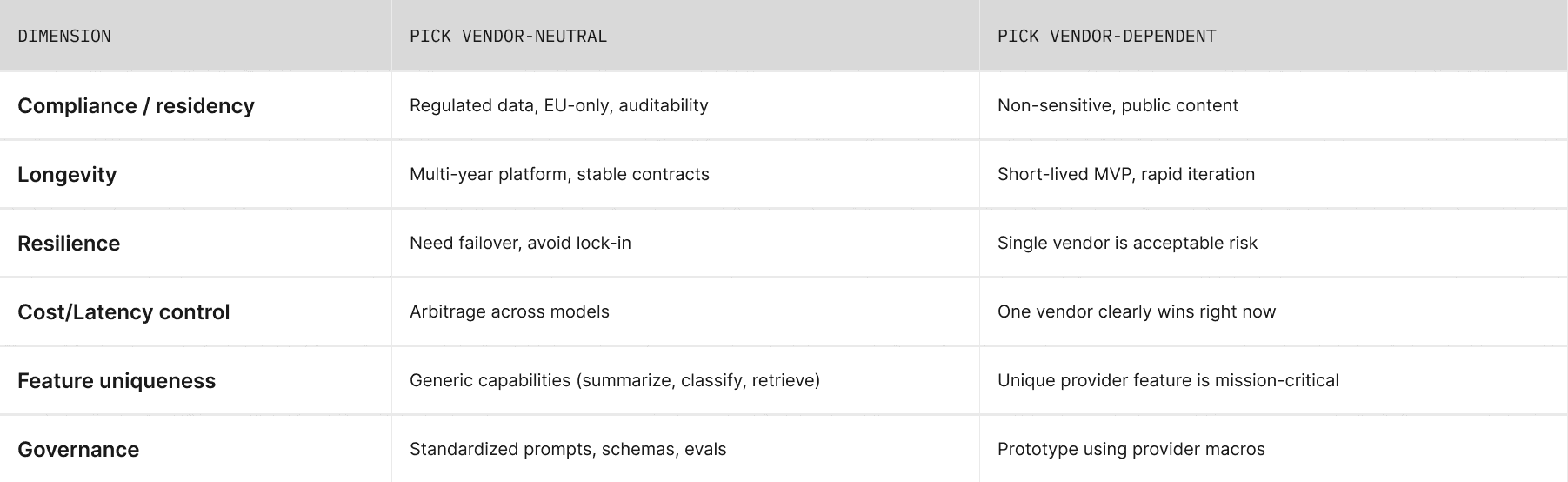
AEAs work best with a hybrid mix: keep the core agent layer vendor-neutral, and allow vendor-dependent agents at the edges where a specific provider gives you a clear advantage.
How to decide (fast rule of thumb)
Core reasoning, routing, memory, guardrails, and artifact pipelines → Vendor-neutral.
You need portability, policy control, and long-term stability here.Edge capabilities with a clear, unique advantage (e.g., a best-in-class vision model, proprietary tool calling, or on-device ASR) → Vendor-dependent is OK, wrapped behind a capability interface so you can swap later.
AEAs work best with a hybrid mix: keep the core agent layer vendor-neutral, and allow vendor-dependent agents at the edges where a specific provider gives you a clear advantage.
How to decide (fast rule of thumb)
Core reasoning, routing, memory, guardrails, and artifact pipelines → Vendor-neutral.
You need portability, policy control, and long-term stability here.Edge capabilities with a clear, unique advantage (e.g., a best-in-class vision model, proprietary tool calling, or on-device ASR) → Vendor-dependent is OK, wrapped behind a capability interface so you can swap later.
AEAs work best with a hybrid mix: keep the core agent layer vendor-neutral, and allow vendor-dependent agents at the edges where a specific provider gives you a clear advantage.
How to decide (fast rule of thumb)
Core reasoning, routing, memory, guardrails, and artifact pipelines → Vendor-neutral.
You need portability, policy control, and long-term stability here.Edge capabilities with a clear, unique advantage (e.g., a best-in-class vision model, proprietary tool calling, or on-device ASR) → Vendor-dependent is OK, wrapped behind a capability interface so you can swap later.
Decision matrix
Recommended AEA layering
Orchestrator / Router (journey brain) – vendor-neutral
Policy, safety, routing, retries, cost/latency budgets, eval hooks.
Core agents (state + artifacts) – mostly vendor-neutral
Reasoning agents, redaction/guardrail agents, retrieval/summarization, validators.
Stable JSON I/O, deterministic modes, content-addressed caching, lineage.
Capability adapters (provider edges) – pluggable
Text generation, embeddings, vision, TTS/ASR, rerankers.
Multiple adapters (OpenAI/Anthropic/Google/Mistral/local). Swap by policy.
Specialized vendor agents (optional) – vendor-dependent but wrapped
If you need a provider’s unique tool-calling or vision segmentation, keep it behind a capability interface with graceful degradation.
Examples
Vendor-neutral core agent (recommended):
Classification/triage agent → Takes JSON schema of labels; calls a
TextGeneratecapability (adapter decides vendor). Deterministic (temp=0), evaluated across multiple models.
Vendor-dependent edge agent (acceptable):
Vision inspection agent → Uses a provider’s unique region-mask API for images. Wrapped as
VisionAnalyze. If provider unavailable, degrade to full-image caption + heuristic crops.
Practical strategy
Design contracts first: JSON schemas for inputs/outputs; reject out-of-spec.
Abstract capabilities:
TextGenerate,Embed,VisionAnalyze,Moderate,ToolExec.Centralize routing/policy: Cost, privacy, region, SLA in the router—not in agents.
Keep prompts portable: No provider macros; version with hashes + dependency metadata.
Evaluate across vendors: Golden sets, cost/latency dashboards, weekly arbitrage.
Plan graceful degradation: If a vendor feature disappears, you still deliver a baseline.
To enable robust AEAs, make the architecture vendor-neutral; make individual agents vendor-neutral by default.
Use vendor-dependent agents only where a unique capability is truly worth it, and always wrap them behind capability interfaces so your experience remains portable, trustworthy, and evolvable.
Recommended AEA layering
Orchestrator / Router (journey brain) – vendor-neutral
Policy, safety, routing, retries, cost/latency budgets, eval hooks.
Core agents (state + artifacts) – mostly vendor-neutral
Reasoning agents, redaction/guardrail agents, retrieval/summarization, validators.
Stable JSON I/O, deterministic modes, content-addressed caching, lineage.
Capability adapters (provider edges) – pluggable
Text generation, embeddings, vision, TTS/ASR, rerankers.
Multiple adapters (OpenAI/Anthropic/Google/Mistral/local). Swap by policy.
Specialized vendor agents (optional) – vendor-dependent but wrapped
If you need a provider’s unique tool-calling or vision segmentation, keep it behind a capability interface with graceful degradation.
Examples
Vendor-neutral core agent (recommended):
Classification/triage agent → Takes JSON schema of labels; calls a
TextGeneratecapability (adapter decides vendor). Deterministic (temp=0), evaluated across multiple models.
Vendor-dependent edge agent (acceptable):
Vision inspection agent → Uses a provider’s unique region-mask API for images. Wrapped as
VisionAnalyze. If provider unavailable, degrade to full-image caption + heuristic crops.
Practical strategy
Design contracts first: JSON schemas for inputs/outputs; reject out-of-spec.
Abstract capabilities:
TextGenerate,Embed,VisionAnalyze,Moderate,ToolExec.Centralize routing/policy: Cost, privacy, region, SLA in the router—not in agents.
Keep prompts portable: No provider macros; version with hashes + dependency metadata.
Evaluate across vendors: Golden sets, cost/latency dashboards, weekly arbitrage.
Plan graceful degradation: If a vendor feature disappears, you still deliver a baseline.
To enable robust AEAs, make the architecture vendor-neutral; make individual agents vendor-neutral by default.
Use vendor-dependent agents only where a unique capability is truly worth it, and always wrap them behind capability interfaces so your experience remains portable, trustworthy, and evolvable.
Recommended AEA layering
Orchestrator / Router (journey brain) – vendor-neutral
Policy, safety, routing, retries, cost/latency budgets, eval hooks.
Core agents (state + artifacts) – mostly vendor-neutral
Reasoning agents, redaction/guardrail agents, retrieval/summarization, validators.
Stable JSON I/O, deterministic modes, content-addressed caching, lineage.
Capability adapters (provider edges) – pluggable
Text generation, embeddings, vision, TTS/ASR, rerankers.
Multiple adapters (OpenAI/Anthropic/Google/Mistral/local). Swap by policy.
Specialized vendor agents (optional) – vendor-dependent but wrapped
If you need a provider’s unique tool-calling or vision segmentation, keep it behind a capability interface with graceful degradation.
Examples
Vendor-neutral core agent (recommended):
Classification/triage agent → Takes JSON schema of labels; calls a
TextGeneratecapability (adapter decides vendor). Deterministic (temp=0), evaluated across multiple models.
Vendor-dependent edge agent (acceptable):
Vision inspection agent → Uses a provider’s unique region-mask API for images. Wrapped as
VisionAnalyze. If provider unavailable, degrade to full-image caption + heuristic crops.
Practical strategy
Design contracts first: JSON schemas for inputs/outputs; reject out-of-spec.
Abstract capabilities:
TextGenerate,Embed,VisionAnalyze,Moderate,ToolExec.Centralize routing/policy: Cost, privacy, region, SLA in the router—not in agents.
Keep prompts portable: No provider macros; version with hashes + dependency metadata.
Evaluate across vendors: Golden sets, cost/latency dashboards, weekly arbitrage.
Plan graceful degradation: If a vendor feature disappears, you still deliver a baseline.
To enable robust AEAs, make the architecture vendor-neutral; make individual agents vendor-neutral by default.
Use vendor-dependent agents only where a unique capability is truly worth it, and always wrap them behind capability interfaces so your experience remains portable, trustworthy, and evolvable.
Strategy to Build Vendor-Neutral Agents
Strategy to Build Vendor-Neutral Agents
Strategy to Build Vendor-Neutral Agents
1) Separate capabilities from providers
Define what the agent needs in plain terms: “chat/complete, embed, rerank, vision, tool-use, function-call, JSON mode, structured output, streaming”.
Create a Capability Interface for each (e.g.,
TextGenerate,Embed,Rerank,VisionAnalyze).Map each provider (OpenAI, Anthropic, Google, Mistral, local) to those interfaces via adapters.
Result: your agent “asks for a capability,” not “calls Vendor X.”
2) Standardize data contracts
JSON Schemas for agent inputs/outputs; reject out-of-spec requests.
Model-agnostic messages (
role,content,tools) → translate in adapters to each vendor’s format.Structured output: always request/validate JSON against schema; never rely on vendor-specific “JSON mode” quirks.
3) Centralize routing & policy
Keep routing decisions outside the agent (in a Router/Orchestrator):
Route by cost/latency, privacy tier, capability fitness, region/compliance.
Policies (PII, region, caching) live in the router; the agent remains pure.
4) Make prompts portable
Author prompts with vendor-agnostic tokens; avoid provider macros.
Keep prompt templates with variables; version them with hashes and dependency metadata (
model_family,schema_version).
5) Encapsulate vendor features
If you use a unique feature (e.g., “tools”, “function calls”, “vision with region masks”), wrap it as a capability with graceful degradation:
If Vendor A supports JSON tools and Vendor B doesn’t, fall back to text instructions + output validation.
6) Evaluation that survives vendor swaps
Build an eval harness that runs the same golden prompts/tasks across providers and logs:
Accuracy/utility metrics, latency, cost, safety flags.
Keep provider choice a config value; the agent contract stays constant.
7) Observability & provenance
Log model_id, adapter_id, prompt_hash, schema_version, temperature/seed, tool calls, cache keys, and decision traces.
This makes swapping vendors auditable and low-risk.
8) Caching & determinism
Cache at capability boundary (e.g., completion result for a given prompt hash + policy hash), not vendor boundary.
For cacheable nodes, use temperature=0 / fixed seed to ensure reproducibility across vendors.
9) Deployment & rollout safety
Version agents (
agent@vN) and adapters (openai@vX,anthropic@vY).Blue/green routing and per-tenant/provider feature flags.
1) Separate capabilities from providers
Define what the agent needs in plain terms: “chat/complete, embed, rerank, vision, tool-use, function-call, JSON mode, structured output, streaming”.
Create a Capability Interface for each (e.g.,
TextGenerate,Embed,Rerank,VisionAnalyze).Map each provider (OpenAI, Anthropic, Google, Mistral, local) to those interfaces via adapters.
Result: your agent “asks for a capability,” not “calls Vendor X.”
2) Standardize data contracts
JSON Schemas for agent inputs/outputs; reject out-of-spec requests.
Model-agnostic messages (
role,content,tools) → translate in adapters to each vendor’s format.Structured output: always request/validate JSON against schema; never rely on vendor-specific “JSON mode” quirks.
3) Centralize routing & policy
Keep routing decisions outside the agent (in a Router/Orchestrator):
Route by cost/latency, privacy tier, capability fitness, region/compliance.
Policies (PII, region, caching) live in the router; the agent remains pure.
4) Make prompts portable
Author prompts with vendor-agnostic tokens; avoid provider macros.
Keep prompt templates with variables; version them with hashes and dependency metadata (
model_family,schema_version).
5) Encapsulate vendor features
If you use a unique feature (e.g., “tools”, “function calls”, “vision with region masks”), wrap it as a capability with graceful degradation:
If Vendor A supports JSON tools and Vendor B doesn’t, fall back to text instructions + output validation.
6) Evaluation that survives vendor swaps
Build an eval harness that runs the same golden prompts/tasks across providers and logs:
Accuracy/utility metrics, latency, cost, safety flags.
Keep provider choice a config value; the agent contract stays constant.
7) Observability & provenance
Log model_id, adapter_id, prompt_hash, schema_version, temperature/seed, tool calls, cache keys, and decision traces.
This makes swapping vendors auditable and low-risk.
8) Caching & determinism
Cache at capability boundary (e.g., completion result for a given prompt hash + policy hash), not vendor boundary.
For cacheable nodes, use temperature=0 / fixed seed to ensure reproducibility across vendors.
9) Deployment & rollout safety
Version agents (
agent@vN) and adapters (openai@vX,anthropic@vY).Blue/green routing and per-tenant/provider feature flags.
1) Separate capabilities from providers
Define what the agent needs in plain terms: “chat/complete, embed, rerank, vision, tool-use, function-call, JSON mode, structured output, streaming”.
Create a Capability Interface for each (e.g.,
TextGenerate,Embed,Rerank,VisionAnalyze).Map each provider (OpenAI, Anthropic, Google, Mistral, local) to those interfaces via adapters.
Result: your agent “asks for a capability,” not “calls Vendor X.”
2) Standardize data contracts
JSON Schemas for agent inputs/outputs; reject out-of-spec requests.
Model-agnostic messages (
role,content,tools) → translate in adapters to each vendor’s format.Structured output: always request/validate JSON against schema; never rely on vendor-specific “JSON mode” quirks.
3) Centralize routing & policy
Keep routing decisions outside the agent (in a Router/Orchestrator):
Route by cost/latency, privacy tier, capability fitness, region/compliance.
Policies (PII, region, caching) live in the router; the agent remains pure.
4) Make prompts portable
Author prompts with vendor-agnostic tokens; avoid provider macros.
Keep prompt templates with variables; version them with hashes and dependency metadata (
model_family,schema_version).
5) Encapsulate vendor features
If you use a unique feature (e.g., “tools”, “function calls”, “vision with region masks”), wrap it as a capability with graceful degradation:
If Vendor A supports JSON tools and Vendor B doesn’t, fall back to text instructions + output validation.
6) Evaluation that survives vendor swaps
Build an eval harness that runs the same golden prompts/tasks across providers and logs:
Accuracy/utility metrics, latency, cost, safety flags.
Keep provider choice a config value; the agent contract stays constant.
7) Observability & provenance
Log model_id, adapter_id, prompt_hash, schema_version, temperature/seed, tool calls, cache keys, and decision traces.
This makes swapping vendors auditable and low-risk.
8) Caching & determinism
Cache at capability boundary (e.g., completion result for a given prompt hash + policy hash), not vendor boundary.
For cacheable nodes, use temperature=0 / fixed seed to ensure reproducibility across vendors.
9) Deployment & rollout safety
Version agents (
agent@vN) and adapters (openai@vX,anthropic@vY).Blue/green routing and per-tenant/provider feature flags.
Featured AEA projects
More projects









Ready to start?
Get in touch
Whether you have questions or just want to explore options, I'm here.

Ready to start?
Get in touch
Whether you have questions or just want to explore options, I'm here.
Ready to start?
Get in touch
Whether you have questions or just want to explore options, I'm here.